Cure Time
UV vs. LED Nail Lamps: What the Difference Actually Is
Both cure gel polish, both emit UVA, and the wattage number on the box tells you less than the wavelength and the cure time.
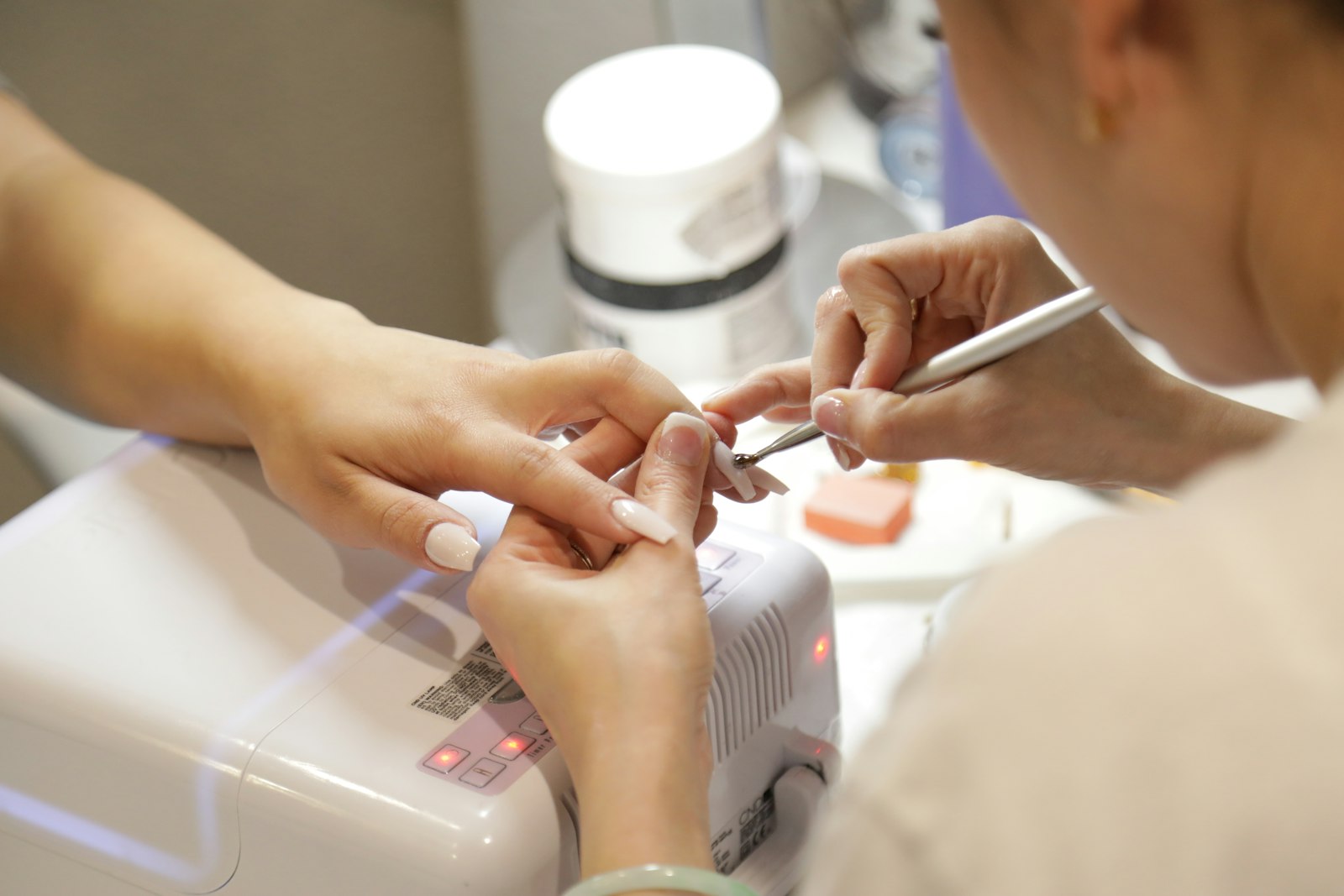
Every gel manicure depends on one thing: the polish must cure completely. A lamp that under-cures produces a manicure that chips early and, more importantly, leaves uncured monomers on the nail plate — which is how people develop acrylate allergies.
That makes the lamp more important than the polish.
UV vs. LED, accurately
Both cure gels by emitting UVA. The difference is the spectrum and the intensity.
| UV lamp | LED lamp | |
|---|---|---|
| Spectrum | Broad UVA (315–400nm) | Narrow UVA (usually ~365–405nm) |
| Cure time | 2–3 minutes | 30–60 seconds |
| Bulb life | Needs replacement | Lasts years |
| Heat | Higher | Lower |
| Coverage | Even across the tube | Can have dead spots |
LED is not “UV-free”. It is UVA in a narrower band, delivered faster. Total exposure per manicure is usually lower with LED because the cure is shorter, but the exposure is not zero.
Why wavelength matters
Gel polish contains photoinitiators that react to specific wavelengths. A polish formulated for 365nm will not cure properly under a lamp peaking at 405nm, and vice versa.
Most modern consumer gels are formulated for the 365–405nm range, which is why “LED/UV compatible” appears on the bottle. If a polish says UV-only, an LED lamp may under-cure it.
The practical rule: match the lamp to the polish system, ideally buying them from the same manufacturer.
What to look for
Reflectors inside the chamber. A lamp with mirrored interior cures more evenly than a bare plastic cavity.
Enough power for the whole hand. 36–48W is typical for a four-finger lamp. Low-wattage lamps cure the centre of the hand but under-cure the pinky and thumb.
A removable base. Lets you fit a foot in for pedicures and makes cleaning possible.
Timer options. 30/60/90 seconds covers most systems.
Open or closed design. Open-front lamps let you pull your hand out fast if the “heat spike” is uncomfortable. That spike is normal — it is the exothermic cure — but it is unpleasant.
The under-curing problem
Under-cured gel looks fine for a few days, then fails: lifting at the edges, peeling in sheets, or a dull surface that never fully hardened.
It also leaves unreacted methacrylates on the skin. Repeated exposure is the documented route to acrylate allergy, which is permanent and means no more gel, acrylic or many dental materials.
If your manicures consistently peel early, suspect the lamp before the polish.
Safe use
- Apply sunscreen to hands or wear UV-protective gloves with fingertips cut out
- Keep skin contact with gel minimal — wipe any that touches skin before curing
- Do not cure polish that has pooled on the cuticle
- Take breaks between gel sets to let the nail plate recover
Bottom line
Buy a lamp matched to your gel system, with reflectors and enough power for a full hand. Do not chase wattage. And take under-curing seriously — it is a health issue, not just a chipping issue.
Links on this page go to retailer search results — check the wavelength range and wattage on the listing, and match it to the gel you use.
Tested Glow may earn a commission from links on this page. This is general guidance, not medical advice; allergy concerns should be assessed by a clinician.
Frequently asked
Is LED safer than UV for nails?
LED lamps emit UVA in a narrower band and cure faster, so total exposure per manicure is lower. Neither is UV-free. The exposure from a few minutes per month is small, but it is not zero.
Can I use any lamp with any gel polish?
Not reliably. Gels are formulated for specific wavelength ranges. A mismatch causes under-curing, which leads to chipping and, more importantly, allergic sensitisation over time.
Why does my gel peel after three days?
Usually under-curing, surface contamination before application, or skipping the base coat. Under-curing is the most common and the most consequential.